Introduction
The global economy in 2026 feels unusually interconnected. A military escalation in West Asia is no longer just a regional issue—it is directly influencing fuel prices in India, construction costs in Delhi-NCR, and even the confidence of homebuyers searching for apartments in Gurugram and Noida.
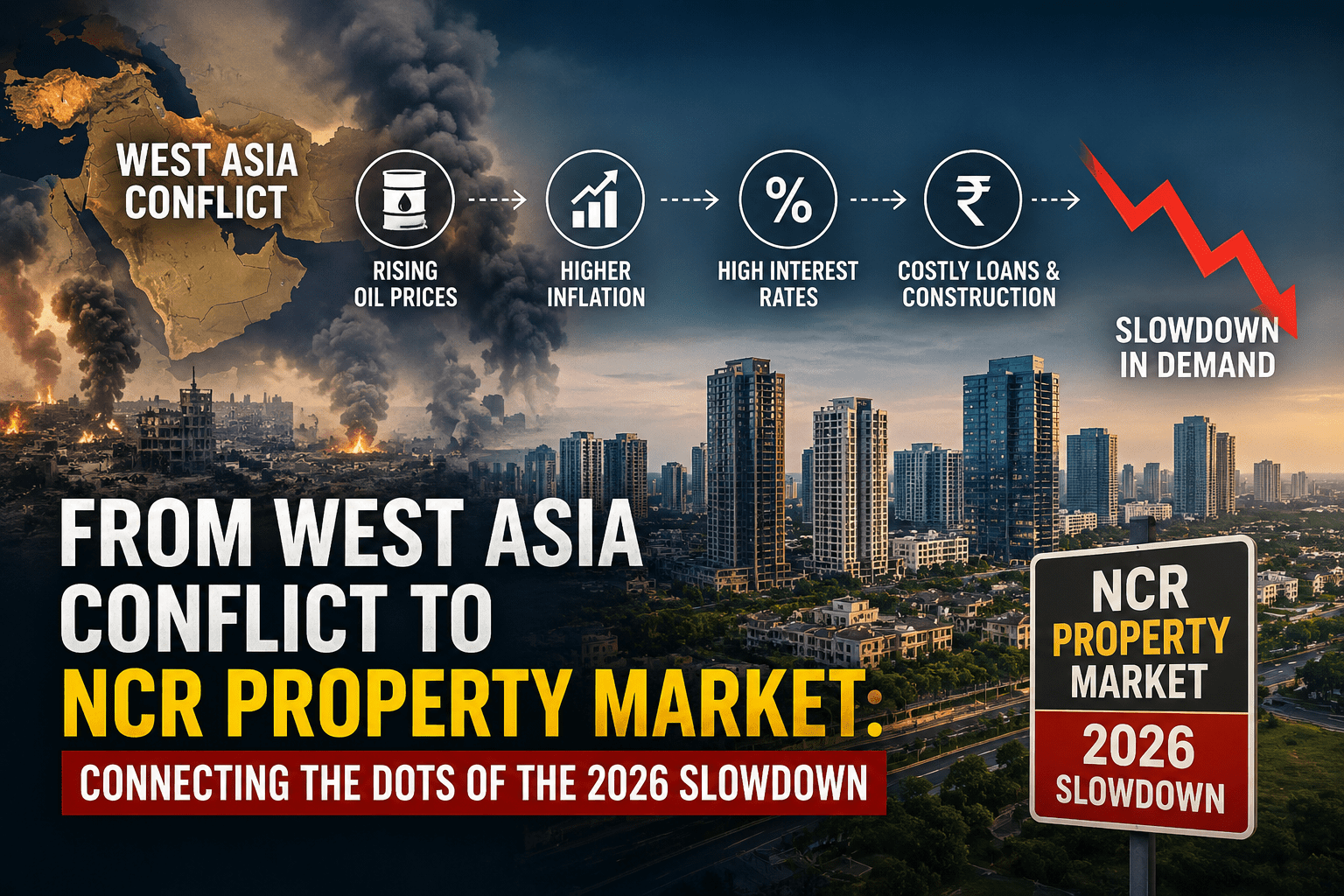
The phrase “From West Asia Conflict to NCR Property Market: Connecting the Dots of the 2026 Slowdown” perfectly captures this chain reaction. What begins as geopolitical instability thousands of kilometers away eventually impacts middle-class homebuyers, developers, investors, and banks across India’s National Capital Region (NCR).
For years, NCR real estate enjoyed strong momentum. Luxury launches surged, infrastructure expanded rapidly, and investors poured money into both residential and commercial projects. But 2026 has introduced new uncertainty. Property inquiries are slowing, inventory cycles are lengthening, and buyers are becoming cautious.
So how exactly does conflict in West Asia affect apartments in Noida or office spaces in Gurugram? Let’s break it down step by step.
Understanding the West Asia Conflict in 2026
West Asia remains one of the world’s most strategically important regions because of its control over global energy supply routes. In 2026, tensions involving regional powers disrupted shipping lanes, increased military spending, and created uncertainty in oil markets.
Why This Matters Globally
The region controls a significant portion of crude oil exports. Any disruption immediately affects:
- Global oil prices
- Shipping insurance costs
- Supply chain reliability
- Currency stability
- Investor confidence
Even temporary instability creates panic in commodity markets. International investors often move funds away from riskier economies during such periods.
India, which imports a large share of its energy requirements, becomes especially vulnerable.
How Rising Oil Prices Affect India
When oil prices rise sharply, the effects spread across almost every sector of the Indian economy.
Transportation Costs Increase
Construction materials like steel, cement, glass, and tiles rely heavily on transportation networks. Higher diesel and fuel prices increase logistics costs almost immediately.
Manufacturing Becomes More Expensive
Factories producing construction materials also face higher operating expenses due to increased energy costs.
Inflation Rises
As prices rise across industries, inflation becomes difficult to control. The Reserve Bank of India (RBI) may respond by maintaining higher interest rates for a longer period.
That creates direct pressure on the property market.

The Link Between Interest Rates and Real Estate
Real estate depends heavily on affordable financing.
When inflation rises:
- Central banks avoid cutting interest rates.
- Home loan EMIs remain expensive.
- Buyers postpone purchases.
- Developers slow new launches.
In 2026, many NCR buyers are taking a “wait-and-watch” approach because financing costs remain elevated.
For example:
- A small increase in home loan rates can significantly increase EMI burdens.
- Investors expecting quick appreciation become cautious.
- First-time buyers delay purchases entirely.
The result? Demand softens.
Why NCR Is More Sensitive Than Other Markets
The NCR property market is unique because it combines:
- End-user demand
- Investor-driven luxury segments
- Commercial office expansion
- Startup ecosystem growth
This makes NCR highly responsive to economic sentiment.
Luxury Segment Vulnerability
Cities like Gurugram and Noida saw massive luxury housing growth between 2022 and 2025. But luxury real estate is highly dependent on:
- Investor confidence
- Stock market performance
- Corporate bonuses
- Business expansion
Global uncertainty reduces all of these.
Commercial Leasing Slowdown
Multinational corporations often delay office expansion during geopolitical instability. That affects:
- Office leasing demand
- Commercial rents
- Retail occupancy
- New mixed-use developments
NCR’s office market therefore experiences indirect pressure from global tensions.

Construction Costs Are Hurting Developers
One of the biggest hidden impacts of the 2026 slowdown is rising construction costs.
Developers now face:
- Higher steel prices
- Increased cement transportation costs
- More expensive imported fittings
- Rising labor expenses
This creates a difficult situation:
- If developers raise prices, buyers hesitate.
- If developers absorb costs, margins shrink.
Many builders are responding by:
- Delaying launches
- Reducing inventory
- Offering payment flexibility
- Slowing construction timelines
Investor Psychology Plays a Major Role
Real estate markets are emotional as much as financial.
During uncertain global conditions:
- Investors prefer liquidity.
- People hold cash instead of buying property.
- Risk appetite declines.
- Luxury purchases are postponed.
This psychological shift is clearly visible in NCR during 2026.
NRI Investment Patterns Are Changing
Many Non-Resident Indians who invested aggressively in NCR property over recent years are now reassessing global risks and currency volatility.
Some continue investing for long-term value, but speculative buying has slowed considerably.
The Rental Market Is Holding Up Better
Interestingly, rentals remain relatively resilient.
Why?
Because:
- Urban migration continues.
- Professionals still relocate to NCR.
- Companies still require operational offices.
- Young workers prefer renting over buying during uncertain times.
Areas near metro corridors and business districts continue to see stable rental demand.
This has encouraged some investors to shift focus from appreciation-driven investing to rental-yield strategies.
Which NCR Segments Are Most Affected?
Most Vulnerable
- Ultra-luxury apartments
- Premium speculative investments
- Commercial office expansions
- Large township launches
More Resilient
- Mid-income housing
- Affordable apartments
- Rental-focused developments
- Transit-oriented projects
Projects near infrastructure corridors still maintain reasonable traction.
Can Infrastructure Save NCR Real Estate?
Infrastructure remains NCR’s biggest long-term strength.
Major projects continue to support confidence:
- Dwarka Expressway expansion
- Metro connectivity growth
- Regional Rapid Transit System (RRTS)
- Noida International Airport development
These projects improve long-term livability and investment attractiveness.
Even during slowdowns, infrastructure-led micro-markets often recover faster than speculative zones.
How Homebuyers Are Responding in 2026
Today’s buyers are more informed and cautious.
They are prioritizing:
- Trusted developers
- Ready-to-move properties
- Lower debt exposure
- Better connectivity
- Genuine end-use value
This is creating a healthier market structure compared to previous speculative cycles.
Will NCR Property Prices Crash?
A full-scale crash appears unlikely.
Why?
- Unsold inventory is lower than past cycles.
- Regulatory reforms improved transparency.
- Developers are financially more disciplined.
- Demand still exists in key corridors.
However, price growth may remain slow for some time.
Instead of dramatic crashes, the market may experience:
- Longer selling cycles
- Negotiation-driven deals
- Selective corrections
- Slower appreciation
Long-Term Outlook for NCR Real Estate
Despite short-term uncertainty, NCR still benefits from:
- Strong urbanization
- Expanding infrastructure
- Corporate concentration
- Population growth
- Rising income levels
The current slowdown may ultimately reset the market into a more sustainable growth phase.
For long-term buyers, periods of caution often create better negotiation opportunities.
Frequently Asked Questions (FAQs)
1. How does West Asia conflict affect NCR real estate?
The conflict raises oil prices, increases inflation, and keeps interest rates high, which reduces property demand and investor confidence in NCR.
2. Are NCR property prices falling in 2026?
Prices are not crashing broadly, but appreciation has slowed and negotiations have increased in several segments.
3. Which NCR areas remain strong despite the slowdown?
Infrastructure-led locations near metro lines, expressways, and airport projects remain relatively resilient.
4. Is this a good time to buy property in NCR?
For long-term end-users, 2026 may provide favorable negotiation opportunities and flexible payment plans.
5. Why are developers delaying launches?
Rising construction costs, uncertain demand, and financing pressure are causing developers to act cautiously.
6. Will interest rates come down soon?
That depends largely on inflation trends and global energy prices linked to geopolitical stability.
Conclusion
The story of “From West Asia Conflict to NCR Property Market: Connecting the Dots of the 2026 Slowdown” reveals how deeply interconnected today’s world has become.
A geopolitical conflict in West Asia can trigger:
- Oil price shocks
- Inflationary pressure
- Higher interest rates
- Investor caution
- Slower property demand in NCR
Yet the slowdown is not necessarily a sign of collapse. Instead, it may represent a transition toward a more balanced and mature real estate market.
For buyers, investors, and developers alike, understanding these global-to-local connections is essential for making smarter decisions in 2026 and beyond.
For additional economic insights, visit Reserve Bank of India and Ministry of Housing and Urban Affairs.




Join The Discussion